Quick Facts
A reform-minded priest who ignited Mexico's independence struggle with bold sermons, radical ideals, and defiant leadership.
Conversation Starters
Life Journey
Born into a criollo family in Corralejo, part of the prosperous Bajio region of New Spain. His upbringing amid estates and Indigenous communities later informed his concern for inequality and local grievances.
As a teenager he moved to Valladolid to pursue advanced schooling at a religious college. The city was a major clerical center, exposing him early to church politics, scholarship, and social tensions in New Spain.
He deepened his theological and philosophical training while building a reputation for sharp intellect. His studies coincided with Bourbon reforms that tightened Spanish control and reshaped colonial administration.
He was ordained and entered the secular clergy, a path that offered influence in colonial society. Parish work brought him into daily contact with Indigenous and mestizo families burdened by tribute and hardship.
He became associated with the Colegio de San Nicolas, a leading institution for clerical education. There he taught and debated new currents of thought, gaining prominence among students and fellow priests.
As rector he encouraged languages, philosophy, and practical learning, drawing on Enlightenment-era ideas circulating in the Spanish world. His style and independence sometimes clashed with conservative expectations of colonial clergy.
After friction with ecclesiastical superiors, he was reassigned away from academic leadership. The move curtailed his influence in Valladolid but pushed him closer to parish life and the economic realities of rural communities.
He took charge of the parish in Dolores, a small town where he became a local leader beyond the pulpit. He supported workshops and agriculture, seeking to improve livelihoods in a region strained by colonial taxation and monopoly.
Napoleon's invasion and the captivity of Ferdinand VII destabilized legitimacy across the Spanish Empire. In New Spain, debates over sovereignty and governance sharpened, and Hidalgo watched unrest spread among creoles and townspeople.
He engaged with networks discussing a break from peninsular control, linking local discontent with broader political ideas. Meetings and correspondence connected him to future allies such as Ignacio Allende and Juan Aldama.
In Queretaro, conspirators including Josefa Ortiz de Dominguez hosted clandestine gatherings to plan an uprising. Hidalgo became a key figure as the plot shifted from reformist talk to preparations for armed revolt.
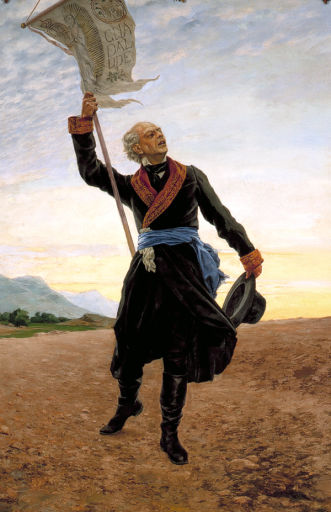
In the early hours he rang the church bell and urged townspeople to rise against colonial authorities, launching the independence movement. His call quickly drew Indigenous and mestizo supporters, turning a conspiracy into mass revolt.
Rebel forces surged into Guanajuato and took the Alhondiga de Granaditas, a pivotal early victory. The violence that followed alarmed elites and hardened royalist resistance, complicating Hidalgo's bid for broad legitimacy.
Hidalgo's army defeated royalists at Monte de las Cruces, opening a path toward the capital. Near Mexico City, difficult choices about discipline, supply, and politics shaped the movement's momentum and public perception.
Royalist forces under Felix Maria Calleja crushed the insurgents at the Battle of Calderon Bridge, shattering their main army. The defeat forced leaders to retreat north, exposing deep strategic disagreements within the rebellion.
During the retreat toward the U.S. border, the insurgent leadership was betrayed and seized at Acatita de Bajan. Hidalgo, Allende, and others were taken into custody, ending his direct command of the uprising.
He faced interrogation and trial by church and royalist officials seeking to delegitimize him as a priest. Proceedings emphasized rebellion and doctrine, while the empire aimed to deter further insurrection through public punishment.
He was executed by firing squad in Chihuahua, ending the life of the movement's most famous early leader. His death transformed him into a martyr for independence, inspiring later leaders who carried the struggle forward.