Quick Facts
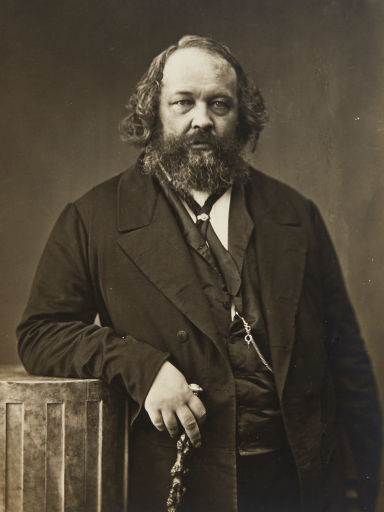
A fiery Russian revolutionary who shaped anarchism through exile, insurrectionary organizing, and uncompromising anti-authoritarian philosophy across Europe.
Conversation Starters
Life Journey
Born to a Russian noble family on the Pryamukhino estate, he grew up amid gentry culture and Enlightenment reading. The rural setting in Tver Province shaped his early sense of hierarchy, duty, and rebellion.
As a teenager he entered military training in Saint Petersburg, preparing for service in the Tsar’s army. The rigid discipline and courtly bureaucracy sharpened his disdain for command and coercion.
He left the army and moved into Moscow’s intellectual circles, debating philosophy and politics with radical-minded friends. There he immersed himself in German idealism, especially Hegel, and began imagining revolutionary change.
He traveled to Berlin to study and join the vibrant expatriate and student milieu. Exposure to European radical networks and censorship battles pushed him from abstract philosophy toward practical insurrectionary politics.
In German radical press he published 'The Reaction in Germany,' closing with a call for destruction as a creative force. The essay made him notorious among authorities and celebrated among revolutionaries across Europe.
After refusing Tsarist orders to return, he was declared an exile and gravitated to Paris’s émigré politics. He met Pierre-Joseph Proudhon and other radicals, deepening his hostility to state power and clerical authority.
In Paris he met Karl Marx and engaged the era’s most intense arguments over revolution, class, and the state. Their early contact foreshadowed a later rupture between libertarian revolution and centralized party strategy.
He plunged into the 1848 upheavals, moving through German and Slavic political arenas as monarchies shook. He advocated revolutionary pan-Slavism against empires, while insisting freedom required dismantling oppressive states.
During the Dresden May Uprising he joined barricade fighting alongside revolutionaries such as Richard Wagner. Defeat brought his arrest and transfer among prisons, marking the start of a long cycle of incarceration and repression.
After extradition to Russia he was held in the Peter and Paul Fortress under harsh conditions. Interrogations and isolation tested his resolve, yet he continued to frame rebellion as a moral necessity against tyranny.
Authorities exiled him to Siberia, relocating him far from European conspiracies yet not from political imagination. In the vast imperial frontier, he observed colonial administration firsthand and hardened his anti-state conclusions.
He executed a dramatic escape from Siberia, traveling east via the Pacific and slipping through Japan and the United States. Reaching London, he rejoined émigré circles and quickly returned to organizing revolutionary networks.
He moved into Italian revolutionary circles, engaging former Garibaldian and republican militants in debates about federation and popular revolt. Italy’s turbulent politics offered a laboratory for his vision of decentralized, anti-clerical revolution.
He joined the International Workingmen's Association and helped build a libertarian wing rooted in workers’ autonomy. His organizing emphasized federations of sections and strikes, resisting any drift toward party rule from above.
He promoted the Alliance of Socialist Democracy to advance atheism, collectivism, and anti-authoritarian revolution within the International. The move intensified conflict with Marx’s allies, centering on whether a workers’ state would become a new tyranny.
In the chaos of the Franco-Prussian War he rushed to Lyon and backed a radical attempt to proclaim communal revolution. The effort collapsed quickly under military pressure, but it embodied his belief in immediate popular action over parliamentary strategy.
The Paris Commune became, for him, a powerful example of workers governing without a permanent ruling class. He used its suppression to argue that centralized states—whether monarchist or socialist—would crush popular self-management.
At The Hague Congress he and his allies were expelled from the International after bitter disputes over authority and organization. The split helped crystalize anarchism as a distinct current against Marxist centralism in the socialist movement.
Declining health and relentless factional battles pushed him to retreat from constant travel and organizing. He continued writing and advising comrades, shaping anarchist theory while living more quietly near Swiss political exiles.
He died in Bern after years of illness, leaving a legacy carried by anarchists, syndicalists, and anti-authoritarian socialists. Friends and comrades remembered his immense energy, generosity, and uncompromising hatred of domination.