Quick Facts
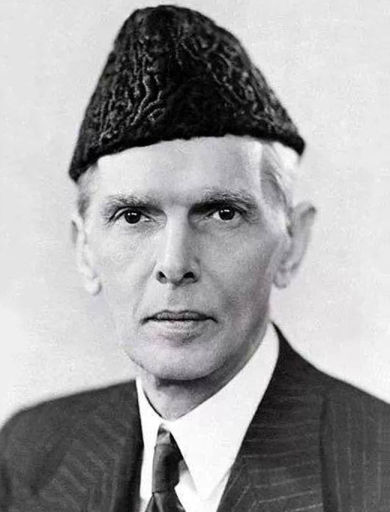
A disciplined constitutional lawyer who steered Muslim politics toward Pakistan through negotiation, strategy, and unwavering resolve.
Conversation Starters
Life Journey
Born as Mahomedali Jinnahbhai in Karachi, then in British India, to Jinnahbhai Poonja and Mithibai. Raised in a commercial milieu shaped by imperial trade and communal diversity, he absorbed discipline and ambition early.
As a teenager, he entered an arranged marriage with Emibai in Karachi, reflecting customary social expectations of the era. The union was brief, and the experience reinforced his preference for independence and a focused public life.
He sailed to London to study law, immersing himself in British parliamentary culture and courtroom practice. The city’s political debates and legal institutions sharpened his belief in constitutional methods and civic rights.
He qualified as a barrister at Lincoln's Inn, joining one of England’s most prestigious legal societies. The training cultivated his precise reasoning and austere professionalism, traits that later defined his political persona.
Returning to colonial India, he established himself as a barrister and gradually built credibility through meticulous casework. He soon shifted to Bombay, where commercial courts and nationalist politics offered larger horizons.
He briefly served as a Presidency Magistrate, gaining close exposure to colonial administration and courtroom governance. The appointment added institutional confidence and strengthened his insistence on procedure and evidence.
He aligned with the Indian National Congress’s constitutional wing, advocating self-government through lawful reforms. In the same period, Muslim political organization grew, setting the stage for his later bridge-building role.
Elected from Bombay, he became a prominent voice in the Imperial Legislative Council, pressing for civil liberties and fair governance. His speeches showed a lawyer’s clarity, challenging executive power while seeking workable reforms.
He joined the All-India Muslim League while urging cooperation with the Congress, positioning himself as a mediator in communal politics. His goal was safeguards for Muslims within a constitutional, united India framework.
He played a central role in the Lucknow Pact between the Congress and the Muslim League, securing separate electorates and political assurances. The agreement briefly unified nationalist momentum against British rule through negotiated compromise.
He married Rattanbai "Ruttie" Petit, a young Parsi woman from a prominent Bombay family, drawing intense social attention. Their relationship, strained by expectations and politics, revealed the personal costs of public leadership.
Through the 1920s, he championed legislative politics and opposed mass agitation he viewed as destabilizing, including Gandhi’s civil disobedience methods. In Bombay’s legal and political circles, he earned a reputation for austere integrity.
He presented his Fourteen Points as constitutional demands to protect Muslim political representation in any future Indian federation. The platform responded to the Nehru Report and hardened debates over centralization, minority rights, and safeguards.
Disillusioned by political deadlock, he relocated to London and returned to legal work while observing constitutional negotiations from afar. Friends and colleagues later urged his return, arguing Muslim politics needed disciplined leadership.
He returned to India and took charge of revitalizing the All-India Muslim League, expanding its organization beyond elite circles. Working from Bombay and across provinces, he built a coherent party machine for mass politics.
At the League’s Lahore session, the party adopted a resolution calling for Muslim-majority regions to form "independent states," redefining the movement’s objectives. The demand intensified negotiations with the Congress and the British government.
In the 1946 elections, the Muslim League swept most Muslim seats, strengthening his claim to represent Muslim political aspirations. Talks with the Congress and the Cabinet Mission collapsed, and communal tensions rose across North India.
After the Partition plan, he became the first Governor-General of Pakistan and addressed the Constituent Assembly on equal citizenship and rule of law. Amid refugee crises and violence, he directed state-building under extreme pressure.
Despite worsening illness, he continued guiding Pakistan’s fragile administration, grappling with finance, security, and mass displacement. He died in Karachi, and his funeral drew national mourning as the new state faced uncertain beginnings.