Quick Facts
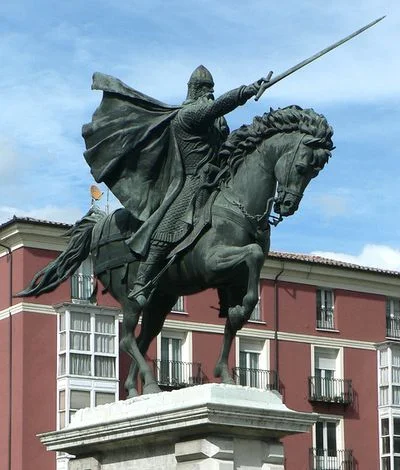
Campeador. Spain's legendary warrior who conquered Valencia and never lost a battle.
Conversation Starters
Life Journey
Rodrigo Díaz de Vivar was born to a minor noble family in the village of Vivar, near Burgos in Castile. His father Diego Laínez was a cavalry officer who had served in the court of Ferdinand I of Castile.
Young Rodrigo was sent to the royal court of Ferdinand I to be educated alongside Prince Sancho. He trained in horsemanship, swordsmanship, and military tactics, forming a close bond with the future king.
Rodrigo fought in his first major battle at Graus, helping Castilian-allied Zaragoza against the Kingdom of Aragon. His prowess in combat began to establish his reputation as an exceptional warrior.
When Sancho II became King of Castile, he appointed Rodrigo as armiger regis (royal standard bearer) and commander of the royal troops. This was the highest military position in the kingdom.
Rodrigo led Castilian forces to victory against King Sancho's brother Alfonso at Llantada. His tactical brilliance in this battle of succession established him as Castile's foremost military commander.
During the siege of Zamora, King Sancho II was assassinated. Though Rodrigo was suspected of involvement, he maintained his honor. He famously made Alfonso VI swear he had no part in Sancho's death.
Rodrigo married Jimena Díaz, a noblewoman of royal blood and niece of Alfonso VI. This marriage elevated his social status and produced three children: Diego, Cristina, and María.
During a mission to collect tribute from the Taifa of Seville, Rodrigo defeated a much larger Granadan army. The Moors began calling him 'El Cid'. (from Arabic 'al-Sayyid,'. meaning 'the Lord'.or 'the Master'.
After unauthorized military action, Alfonso VI exiled Rodrigo from Castile. He offered his services to the Moorish king of Zaragoza, demonstrating the complex Christian-Muslim alliances of the period.
Serving the Taifa of Zaragoza, El Cid won numerous victories against both Christian and Muslim enemies. He defeated the Count of Barcelona twice, capturing him and demanding large ransoms.
El Cid was briefly reconciled with Alfonso VI and returned to Castile. However, political tensions soon led to a second exile, this time permanent. He would never serve a Castilian king again.
El Cid began his campaign to conquer Valencia, the wealthy Taifa on the Mediterranean coast. He systematically weakened the city through sieges, cutting off its food supply and potential allies.
After a 20-month siege, El Cid conquered Valencia and made himself its ruler. He governed both Christians and Muslims with relative tolerance, maintaining Islamic laws for Muslim subjects while encouraging Christian settlement.
El Cid decisively defeated an Almoravid army at Cuarte, outside Valencia. This victory against the North African fundamentalists secured his hold on Valencia and demonstrated his continued military genius.
El Cid's only son Diego was killed at the Battle of Consuegra, fighting against the Almoravids. This devastating loss meant Rodrigo had no male heir to inherit his hard-won conquests.
El Cid died in Valencia, possibly from grief after his son's death or from wounds received in battle. His wife Jimena held Valencia for three more years before abandoning and burning the city. His legend as Spain's greatest hero was born.